


An iconic legacy
From prehistoric times to the present day, human occupation has left many traces, particularly in the form of buildings. These structures reflect an architectural chronology, whether monumental or vernacular. There are buildings dating from the Middle Ages to the Modern and Contemporary periods. Beyond leaving occasional evidence of its passage, it should be emphasised that humankind has shaped the territory as we know it today.
From now on, this iconic heritage must be protected, preserved and renovated where necessary. Each of the six municipalities of the Grand Site de France has a rich and varied built heritage. Comprising religious, military and agricultural buildings, as well as dwellings, this architectural ensemble traces both the local history and that of Corsica. It is now essential to protect and enhance it, in order to pass it on to future generations.
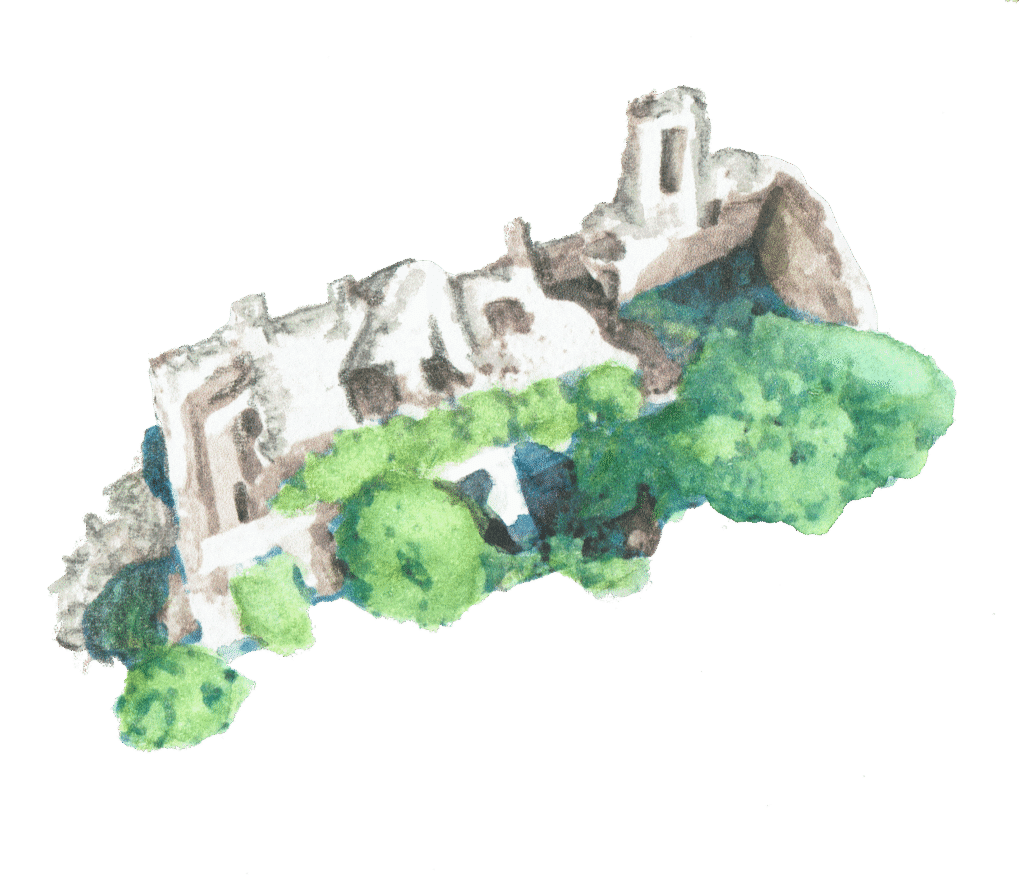
RELIGIOUS HERITAGE
Between faith and landscape
Churches, chapels, convents – so many religious buildings that mark the territory with their style, inherited from the Romanesque and Baroque periods. Beyond their spiritual value, they are visual landmarks in the landscape:
Their familiar silhouettes punctuate the villages and structure the toponymy of the area, like the San Martinu church in Patrimonio, which stands out like a lighthouse in the wine-growing region. Other more discreet buildings, such as the Saint Quilicu chapel or the Marianda convent in Farinole, hidden among the vegetation, are just as remarkable and also echo the collective history of the region.
As a result, the old cathedral of Nebbiu, located in Saint-Florent, is one of the finest examples of Romanesque architecture in Corsica. Baroque art is particularly evident in the interior decoration of religious buildings, as can be seen in the beautiful frescoes in the church of Sant-Andria in Oletta.
Many religious buildings are listed as Historic Monuments in the region:
PARISH CHURCH OF SAN MARTINU - HERITAGE
Built in 1575 in the hamlet of Cardetu, it contains works and artefacts from churches in the surrounding villages (Barbaggio, St Florent and Farinole) that were recovered and preserved by the inhabitants during various wars. The bell was recovered from the St François de Marianda convent (1606) in Farinole. Every year on 11 November, the feast of San Martinu, patron saint of the commune, is celebrated. This religious festival, focused on sharing, brings together several thousand people. More information on the festivals and traditions of the GSF. A procession is formed, made up of brotherhoods from all over Corsica. Blessed by San Martinu, the wines of all the winegrowers of the Patrimonio AOP are honoured and tasted. It is an opportunity to come and discover the vineyard and its inhabitants.
© Andreani Christian; Machline Sarah, “Saint Martin Parish Church, known as San Martinu,” Cultural Media Library of Corsica and Corsicans

THE CHAPEL OF THE SANTA CROCE BROTHERHOOD - POGGIO D’OLETTA

Built in 1666 on a Latin cross plan, it is located below the hamlet of Olivacce, a few metres from the parish church of San Cervone.
SAN QUILICU CHAPEL – POGGIO D’OLETTA
Built in the 11th century not far from the hamlets of Brietta and Casatico, on the plain of Poggio d'Oletta.
The building has an elongated layout consisting of a nave and a semi-circular chevet. Only the walls of the nave and apse remain. The main entrance door is crowned by a stone arch framing a bare tympanum. The town hall of Poggio d'Oletta has a stone decorated with a Christ-like pelican carved from the same stone (cipolin) as the chapel. This sculpture may have been used to decorate the chapel. It is said to have been found near the chapel.
© Andreani Christian; Machline Sarah, “Saint-Cyr Chapel, known as San Quilicu,” Cultural Media Library of Corsica and Corsicans

CHURCH OF SANTA MARIA ASSUNTA – SAINT-FLORENT

The former cathedral of Nebbiu (diocese of Nebbiu before 1789) is also known as the Church of Santa Maria Assunta. It is located on the edge of Saint-Florent, along the road that climbs towards Poggio d'Oletta via Strette di u Poghju. It is a magnificent medieval limestone building that has been well restored and is still sometimes used as a place of worship. The date of its construction is uncertain, but it was built in the 12th century between 1125 and 1140.
The cathedral houses the relics of Saint Flor, a Roman soldier martyred in the 3rd century. Since the 18th century, the relic of the saint, which was given to the Bishop of Nebbiu by Rome, has been celebrated every three years on Whit Monday.
FORMER CONVENT OF SAN FRANCESCU AND ITS CHAPEL
Comprising twenty-five cells, it housed 18 brothers, including three priests and several clerics. Chronicles recount that as early as the 15th century, the priest celebrated mass there with two pistols at the ready to keep the faithful in check. During the struggle for the island's independence, the brothers rode through the countryside on horseback to rally the crowds to the national cause.
In 1768, the French landed at Saint-Florent and seized Oletta. In 1769, they established their headquarters in the convent.
From there, they launched their offensive against Paoli's troops, which came to an end on 8 May 1769 at Ponte-Novu.
The chapel, whose construction dates back to the late 12th and early 13th centuries, is protected and classified as a historic monument by decree of 29 November 1974.

MILITARY HERITAGE
a memory engraved in the landscape
There is also a wealth of military heritage within the Grand Site de France. The presence of coastal towers, a citadel and casemates reveals strategic viewpoints across the area.
Testaments to more unstable times, these defensive structures are reminders of periods of great insecurity, whether during the barbarian invasions, the Pauline era or, more recently, the Second World War.
The citadel of Saint-Florent and the coastal tower of Farinole are two iconic examples of the Genoese period in our region. All of the coastal towers were built between 1530 and 1620 to protect the island's strongholds, such as the citadels of Saint-Florent. In 1630, Corsica had 120 towers; today, 92 remain across the island, including the Farinole tower. The Genoese towers were built by the Republic of Genoa as a means of defending the island against Barbary pirates.
More recently, the area has also seen the construction of buildings inherited from the Second World War: bunkers, the most remarkable of which – because it has been restored – is the Barbaggio bunker at the Teghime Pass. This pass, a strategic location from a military point of view, had already been identified as such when, in 1920, the French Navy installed a radio relay station there between Corsica and Nice. In 1935, with the approach of world war, the site was reinforced militarily. Bastia was the last town on the island to be occupied during the Second World War, so the Allies decided to recapture the town via the Teghime Pass. A dozen bunkers were installed there, which are now hidden in the vegetation.
THE CITADEL OF SAINT-FLORENT
Built by the Doge of Genoa, Giano I di Campofregoso, the citadel was expanded and improved several times, whether by the Genoese in the 16th century, in 1553 by General Paul de La Barthe de Thermes, or in the 18th century when the city consolidated its fortifications. The citadel was transformed again at the end of the 19th century and the beginning of the 20th century. It has retained an 18th-century powder magazine, a former 17th-century chapel, 19th-century prisons and the 15th-16th-century keep (torrione) that commanded the harbour cove. It was from this fort that Pascal Paoli left Corsica in 1795 for his permanent exile in England.

FARINOLE TOWER
Built in 1562 using tax revenue, this Genoese tower, recently acquired by the municipality, was used to warn residents of danger. Fires were lit there to sound the alarm. It can be seen from the Towers of Mortella, Negro and Ogliastro. (Ancient nautical chart – Map of the Isle of Corsica from 1756).
It was in service until the end of the 18th century and had two soldiers and a tower commander. It is a circular tower built of limestone and is of classic design: three levels (blind base, floor with a door and windows, terrace crowned with machicolations). The breach on the west side is the result of an attempt to cut a door in the base. On the sea side, the machicolations have collapsed.
At the foot of the tower are the «Magazini», which were used to store goods (cereals, animals, etc.) that the inhabitants transported from the Nebbiu/Agriate plain by boat (from the Gulf of St Florent to Marine de Farinole).
Next to the tower that also defended it, a shipyard called «U Scalu Vecchju» enabled the construction of a half-galley between January and March 1762 and, at the end of that year, the felucone «Il Terrore», a ship belonging to the Pauline fleet.
© Andreani Christian; Machline Sarah, “entrepôts dits magazini” (warehouses known as magazini), Cultural Media Library of Corsica and Corsicans

AGRICULTURAL HERITAGE
A deeply rooted heritage
Today, vine cultivation is booming and is by far the dominant agricultural activity in the region. Conca d'Oru has a deeply rooted agricultural heritage dating back to ancient times.
. The gradual transition from agrarian agriculture to specialisation in wine production began in the early 20th century. Scattered among the agricultural plots, we find pagliaghji and casette that blend into the landscape thanks to their shapes and construction materials. These small agricultural buildings attest to the past presence of cereal (wheat) plots, orchards (chestnuts, figs, citrons) and olive groves.
These elements of vernacular heritage are now an integral part of the landscape, and their preservation is essential. In 2023, the Syndicat Mixte du Grand Site de France set itself the goal of cataloguing the built agricultural heritage in the area. With the support of architecture students from the University of Montpellier, more than 250 agricultural buildings were inventoried.
This work then led to the launch of ’Operation Dry Stones«, aimed at restoring certain elements of rural heritage that had been damaged by time. It was within this framework that the restoration of two pagliaghji was carried out in the area.
Agricultural buildings present on the Grand Site:
- Dry stone walls: Dry stone walls can be seen here and there within the existing plots. They form part of the architecture of old pastures that are now little used or newly used for outdoor accommodation. These structures contribute to the heritage dimension of the landscape. They bear witness to an ancient history in which agriculture has always been present.
- The mills: Located in the villages, particularly in the cellars of houses or near streams, the mills, whether powered by animals or water, bear witness to the past production of olive oil, cereal flour and chestnut flour.
- Les Casette: A «Casetta» is a shed used to store tools or as temporary shelter depending on weather conditions.
- Fountains: Fountains played an important role in village life before the 1950s. They provided residents with drinking water.
- Threshing floors or Aghje: Used for separating grain from straw by threshing, their presence bears witness to a significant cereal-growing culture in the past. They were located near the fields. Today, they are sometimes hidden by dense vegetation or clearly visible in the vineyards.
- Straw sheds or pagliaghji: A pagliaghju is a small building that was used both as a farm shed for storing straw and as a shelter for shepherds and their animals during transhumance. It is the most common type of farm building in the Grand Site area. Generally speaking, they date from the late 18th and early 19th centuries. The area was once the fourth largest producer of hay and cereals. The pailler is built from materials found on site. The walls are made of dry stone and the roof is made of a layer of rammed earth, often naturally vegetated, or with schist slabs to make it waterproof. Today, there are more than 80 pagliaghji listed on the Grand Site.


MARITIME HERITAGE
When travel shapes stone
Beyond major artistic and historical movements, societal and local ideals have also shaped the landscape, leaving traces of the customs and traditions of a society that no longer exists.
Among these reminders of the past are the so-called «American» houses, or palazzi, built by families who returned from America at the end of the 19th century, as well as the monumental tombs typical of the region. The finest examples of this period can be found in Farinole. One of the most iconic buildings can be seen from the road connecting the hamlet of Bracolacce to the marina of Farinole. It belonged to the Cesari family, one of the most influential in the village. Owning vast tracts of land in the Agriate region – formerly cultivated with wheat by the people of Farinole, who transported the harvests by boat to the marina – this family also made their fortune in the Americas at the end of the 19th century. It was probably on their return that they built this residence and an adjoining funeral chapel.
Some infrastructure inherited from the past has evolved over time, adapting to contemporary uses. This is particularly true of the port of Saint-Florent, which has its origins in an ancient port that played a central role in maritime trade in the Mediterranean basin, helping to open up Corsica to the world.
From maritime trade to recreational boating
Long before the modern port was built, many ships already set sail from the coast of Conca d'Oru to export the region's agricultural produce. An original example of this relationship between wine and the sea is that of the «vini navigati»: wines were loaded onto sailing ships in Saint-Florent, then unloaded in Erbalunga (near Bastia) to be tasted. If the wine had withstood the sea voyage well, it was then shipped on to Genoa. The same was true for other agricultural products such as cereals and fruit, particularly during the Genoese period, when Corsica was considered the breadbasket of the Republic of Genoa.
Today, Saint-Florent, the only village in the area located on the coast, is home to a marina that has become a major tourist and economic hub. With around 960 berths, it is now the largest marina in Corsica. Renowned for its seaside activities, it is also part of a dynamic of environmental innovation. In 2019, the marina was awarded the Blue Flag label in recognition of its sustainable management. It also hosts a fish nursery, called Biohut, thereby contributing to the regeneration of marine biodiversity.

INDUSTRIAL HERITAGE
When the mountain forged the cannon
Traces of the Industrial Revolution are still visible in the Grand Site de France area, particularly in the A Ferrera magnetite mine in Farinole.
This mining operation dates back to around 1450, under the impetus of the Genoese, and is believed to have continued until the 17th century. At the time, the extremely hard rock was first extracted using fire, before black powder was introduced in 1623—one of the first documented uses of this explosive in Europe for mining purposes. The ore was then used to manufacture cannonballs, and a small building was constructed on site by the Genoese.
The mine experienced a revival in 1848 when it reopened to supply the blast furnaces of Toga in Bastia. During this period, new developments were made, including the construction of a powder magazine and the opening of a haulage gallery, allowing ore to be extracted using wagons. The site was finally abandoned at the beginning of the 20th century.